
A Conversation on Environmentally Assisted Cracking, Coating Performance, and Smarter Monitoring
Understanding when and why materials fail has direct implications for asset maintenance, inspection schedules, coating selection, and operational safety. Carly Cocke, Systems Research Engineer with the Acuity corrosion team at Luna Labs, is interested in the conditions that drive structural failure in aerospace and defense systems.
In this conversation, she explains what standard monitoring methods often miss, why surface condition isn’t always a reliable indicator of damage, and what more representative sensing methods are revealing about how materials actually behave in service.
Q: You work at the intersection of corrosion and cracking. For many people, those are the same things. How should they be differentiated?
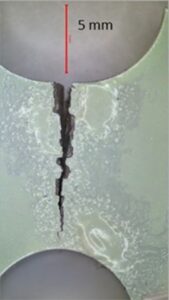
The most accurate way to think about it is a Venn diagram: corrosion in one circle, cracking in another, and environmentally assisted cracking (EAC) where they overlap. EAC occurs when a susceptible material under tensile stress is exposed to conditions, such as humidity, salt, galvanic coupling, crevice geometry, etc., that drive cracking in ways neither the mechanical load nor the environmental exposure would produce on its own. Fifty percent of all metallic structural failures are attributed to fatigue, so fatigue itself is a major infrastructure challenge. If you collapse corrosion or cracking into one broad category, you risk missing the specific variables that control initiation, growth, and long-term performance. In aerospace and defense, those variables have real consequences.
Environmentally assisted cracking on a structural aerospace component
Q: EAC sounds highly specialized. Where does it actually show up in the real world?
It’s more common than most people realize. On bridges, high-strength steel bolts are particularly vulnerable to hydrogen-assisted EAC driven by weather, high relative humidity, and elevated temperatures. In vehicles, fatigue can cause aluminum frame components to crack and eventually catastrophically fail. Corrosion from salted winter roads or exposure to coastal conditions accelerates these cracking processes. For military assets such as aircraft, ships, and defense structures, the stakes are higher still.
These are expensive, high-consequence systems operating in demanding environments, and the cost of maintenance, inspection, and unexpected failure is significant. The field exists because these failure modes are real, they’re ongoing, and they’re worth fully understanding.
Q: Why is early-stage cracking so difficult to manage from a maintenance standpoint?
The most consequential phase is also the least visible. Crack incubation, initiation and small crack growth account for the majority of a cracking process’s total life. During that time, there may be no visually discernable surface indication that anything is happening. By the time a crack is large enough to be detected by conventional inspection, propagation can be relatively rapid.
My doctoral research illustrated this clearly. We corroded aluminum fatigue coupons with fasteners under salt fog conditions, controlling whether corrosion was severe on the surface, severe in the through-hole, or minimal. Regardless of the severity of surface corrosion, fatigue cracks always initiated in the through-hole, which had a higher stress concentration due to the geometry of the through-hole. Even when corrosion was visually severe right next to the hole, cracks still started inside it. Visible surface condition external to a component’s through-hole doesn’t reliably indicate where damage is developing or where to focus inspection efforts.
Q: What are Insight SL and Insight DL, and why does their design matter?
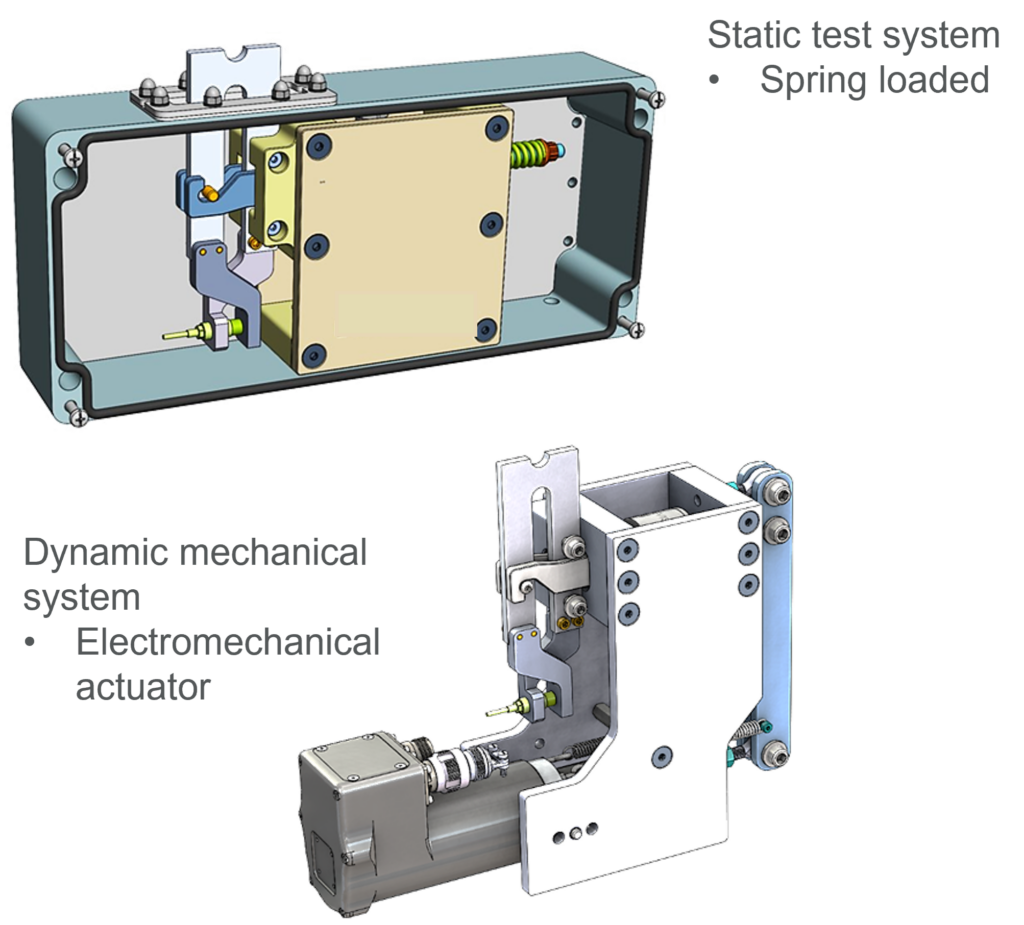
They are products within our Acuity Corrosion Technology portfolio. Insight SL is a static load frame and Insight DL is a mechanically actuated dynamic load frame. Both are sized to fit inside standard accelerated corrosion testing chambers. That’s the key design difference compared to conventional testing apparatuses. Traditionally, researchers adapt a corrosion chamber around a large, fixed load frame, which creates significant constraints on what can be tested and how. With Insight SL and Insight DL, the load frames are adapted to the chambers, which makes combined mechanical-environmental testing more accessible to our own research programs and to external research labs working across the fields where EAC is relevant.
Renderings of Luna Labs Insight Systems
Q: What has the Insight SL primer testing revealed about how coatings perform under combined conditions?
It reinforces that coating performance can’t be evaluated in isolation from the surrounding material system. We’ve tested primer systems under MDACT (Multivariate Dynamic Accelerated Corrosion Testing) with and without a galvanic crevice former simulating a fastener, and we’ve observed meaningful behavioral differences among primer systems under those conditions. Fastener selection, local geometry, and environmental exposure all influence cracking behavior. That’s an important variable to capture, and it’s one that simpler testing protocols can miss.
Q: How does this work connect to the push to move away from chromate coatings?
Their corrosion-inhibiting performance is well established, but they pose real health and environmental risks. The transition to safer alternatives requires evidence. Emerging non-chromate coating systems need to demonstrate they can protect against environmentally assisted cracking under realistic conditions, and that requires methods capable of distinguishing meaningful performance differences. What Insight SL and Insight DL offer is more informative monitoring with faster turnaround and the ability to capture how coatings, fasteners, alloys, and exposure conditions interact in ways that simpler protocols may miss.
Q: Looking at the field broadly, what do you think drives progress in environmentally assisted cracking research?
Better models, better tools, and more people bringing different perspectives to the problems. The computational modeling of crack growth is advancing. Testing that allows more representative experimental conditions are advancing. The testing and basis for safer coating systems to mitigate EAC is being demonstrated and improved upon. Compared to where the field stood when aircraft were first being designed and fielded, the progress is enormous. I know that trajectory continues to accelerate as more researchers enter the space.
We’re moving toward a future where we can predict failure before it happens more reliably, repair damage before it becomes critical without degrading structural integrity, and build systems that are safer and more sustainable
Carly Cocke is a Systems Research Engineer at Luna Labs. She holds a PhD from the University of Virginia, where her research focused on corrosion-nucleated fatigue in aluminum alloy systems. Her background spans infrastructure and transportation with the Virginia Department of Transportation (VDOT), non-destructive

evaluation at the Virginia Transportation Research Council, and materials research in corrosion, metallurgy, and structural fatigue. At Luna Labs, she serves as PI and Co-PI on multiple programs focused on environmentally assisted cracking, coating performance, and advanced test methods for aerospace and defense applications.
Contact Carly and our corrosion team with questions or to inquire about Acuity corrosion solutions.